

Every thought you’ve ever had from “Did I leave the oven on?” to “Why do I feel like this?” has one thing in common: it happens in your mind. But what if you could step outside of that thinking? What if you could watch your thoughts, rather than just have them?
That’s what metacognition means: literally “thinking about thinking”. It’s the capacity to be aware of our mental processes and to regulate them. To notice what we’re thinking, why we’re thinking it, and how our thoughts shape our experience of life. It happens in a nanosecond, and if you catch yourself doing it then congratulations – you are more aware than you were. Think of it as a muscle, your ability will keep growing the more you use it.
In psychology and neuroscience, this skill is considered critical for learning, decision-making, emotional intelligence, and self-awareness. Research shows it isn’t just a philosophical idea but a measurable brain function with profound implications for growth and wellbeing.
What Metacognition Really Is
You’ve probably experienced metacognition without a name for it.
The moment you catch yourself having a thought and then immediately having a thought on top of that one about the thought. It’s as if there’s another layer of yourself, outside of your actual self. The outer observer layer, it doesn’t say much. There’s no chatter, no anxiety, no reasoning, no opinions. It’s just pure observation. Facts.
”That’s metacognition”
That’s metacognition too. (I said it twice because that’s what it feels like).
At its core, metacognition has two parts:
- Awareness: noticing your own thinking, feelings, and internal patterns.
- Control: choosing how to respond to those thoughts rather than being unconsciously pushed around by them.
This isn’t just self-reflection, it’s self-regulation. It’s what allows you to slow down, observe, and then choose a response that isn’t just habitual or reactive.
The Brain and the Observer
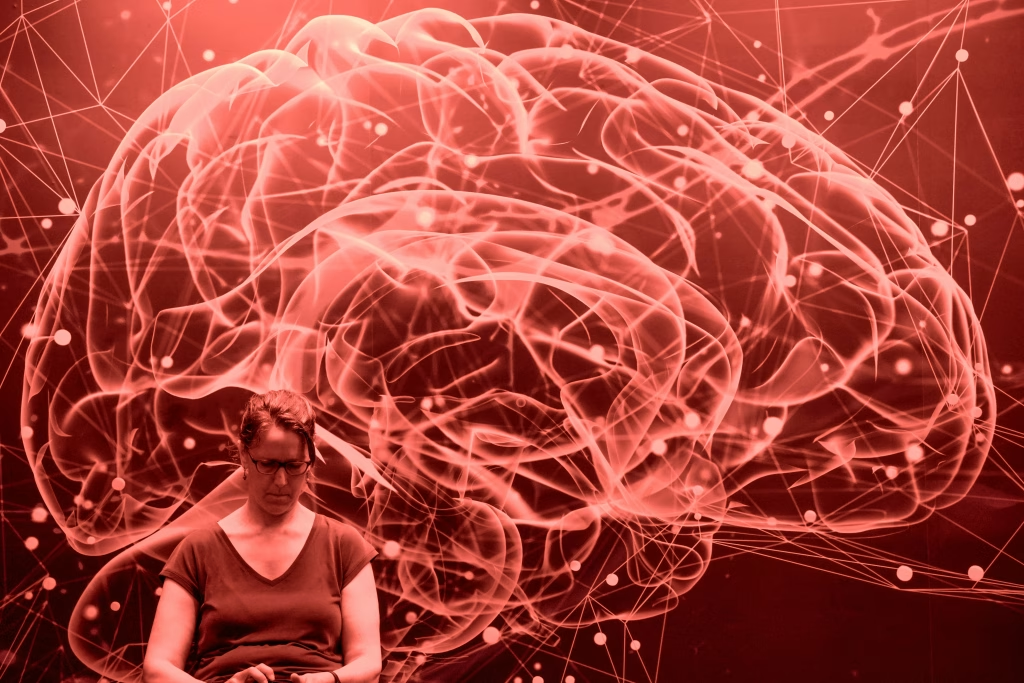
Neuroscience sheds light on what’s happening inside us when we step back from our thoughts. Metacognitive activity is strongly linked with the prefrontal cortex, the part of the brain associated with executive functions like planning, decision-making, and reflective awareness.
When we practice metacognition, we aren’t just thinking, we’re engaging a part of the brain that observes the process of thinking itself. This is why mindfulness and meditative practices so often support metacognition: they strengthen our capacity to notice internal experience without immediately reacting to it.
In experimental psychology, even subtle practices like checking in with your attention during meditation create what researchers call “metacognitive feelings”: mental alerts that say, in effect,
“Whoa — you just wandered off. Take note!”
That moment of “Oh, I wasn’t listening” or “Ah, that’s where the anxiety lives in my body” is a metacognitive signal, and a moment of self witness.
Why It Matters: Metacognition and Learning, Life, and Change
Metacognition isn’t an abstract luxury reserved for yoga retreats and forest bathing, it’s a life skill. And it appears when you are in the kitchen making packed lunches, it’s there when you are in a meeting at work, and when you’re juggling school runs with deadlines, texts from your ex, and a phone that won’t stop buzzing. It shows up in the split second before you snap at a colleague who has just criticised your idea, or when a difficult conversation with your teenager starts to tip into a power struggle. It is present when your manager questions your performance and you feel the heat rise in your chest; when a friend lets you down and you are torn between silence and confrontation; when money worries sit heavy and every small decision feels loaded.
In those moments, metacognition is the quiet voice that asks, What am I thinking right now? What story am I telling myself? Is this reaction helping? It creates a sliver of space between trigger and response. Instead of firing back, shutting down, or spiralling into worst-case scenarios, you notice the pattern forming. You recognise the old script. And with that awareness, even in the middle of a busy, messy, ordinary life, you gain the power to choose differently.
Research in education shows that learners who are better at monitoring and controlling their own thinking perform better. Not because they have more facts, but because they know how to think about the facts they do have.
Beyond school, metacognition plays a role in emotional regulation, resilience, and mental health. People who can observe their emotions and thoughts with curiosity — rather than immediately reacting — are less likely to be swept away by them. They can see, for example, whether a fear is rooted in present reality or an ancient memory playing on repeat.
Even in animals, recent research suggests that the ability to revise beliefs based on evidence, a form of “thinking about thinking”, exists beyond humans, indicating that metacognition is not just a highbrow human construct but a functional cognitive skill with evolutionary roots.
Metacognition Meets Spiritual Awareness
From a spiritual perspective, metacognition can feel like an inner witness. Many contemplative traditions describe this as the power of the observing self noticing the experience without becoming entangled in it.
Science and spirit converge here. Neuroscience gives us the mechanics — brain regions and cognitive processes, while spirituality gives us the meaning: the sense that something in you is more than a set of thoughts.
In this sense, metacognition is like tuning an internal radio to a higher frequency that lets you hear your mind without becoming it. It’s not denial of emotion or suppression of experience, but a widening of awareness that includes both the thinker and the thought.
How to Practice Metacognitive Awareness
You don’t need a PhD or hours of meditation to begin. Here are simple ways people naturally strengthen their capacity to observe their own mind:
- Name the experience
Just saying to yourself, “I notice I’m anxious” activates metacognition. - Pause before reacting
Instead of immediately responding, take a breath and ask, “What is this feeling trying to tell me?” - Ask reflective questions
What was I thinking before I felt this way? What story is my mind telling right now?
Each time you notice your thinking as an observer, you exercise your metacognitive muscle.
Metacognition: A Bridge Between Mind, Science, and Spirit
Metacognition invites us to see inner life with clarity and compassion. It shows us that we don’t have to be victims of thought — that we can observe, understand, and even transform what once controlled us.
It’s scientific enough to be studied in labs.
It’s practical enough to improve learning and emotional wellbeing.
And it’s deep enough to touch the spiritual heart: the part of us that watches, that witnesses, that “is”.
In a world that constantly pulls our attention outward, metacognition invites us inward, not in self-judgment, but in curiosity, presence and compassion. And in that space, real learning happens.